
Raw MEMS accelerometers are inherently noisy. When mounted on vibrating industrial equipment – an excavator, a drilling rig, or a crane boom – their output jumps erratically, making it impossible to distinguish a 2° tilt from a 5° tilt. Traditional fixes like low-pass filters introduce dangerous lag. Expensive “industrial-grade” sensors cost $300–500 but still rely on the same basic MEMS technology.
The real solution lies in firmware: an embedded Kalman filter that fuses sensor data over time, distinguishes vibration from true tilt, and delivers 0.02° angular resolution – a 10× improvement over raw MEMS – with no lag. And thanks to smart engineering, this precision now costs just $99 in the TS-2322-R04 dual-axis inclinometer from AIT Sensing Inc. (AIT).
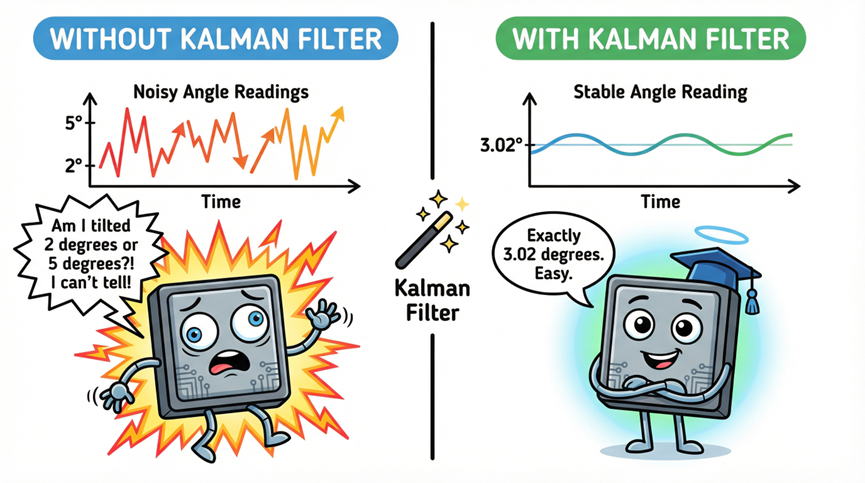
The Noise Problem: Why Raw MEMS Fails in the Field
A MEMS accelerometer measures tilt by sensing the static gravity vector. In a perfect still environment, that works well. But industrial equipment generates broadband vibration – engine rumble, gear meshing, hydraulic hammering – that couples directly into the sensor. The result is a jagged, high-variance output where true tilt is buried under noise.
Simple low-pass filters (e.g., moving average or single-pole IIR) reduce noise but introduce phase lag. If your crane is tilting toward an unsafe angle, a laggy filter means you learn about the tilt too late. For safety-critical applications, that is unacceptable.
The Kalman Filter: A Recursive State Estimator
Developed for the Apollo navigation computers, the Kalman filter is a recursive algorithm that estimates the true state of a dynamic system from a series of noisy measurements. It works in two steps:
- Prediction – The filter projects the current tilt estimate forward in time using a simple motion model (assuming slow changes).
- Update – It compares the predicted tilt against the new raw accelerometer reading, weighting each by their respective uncertainties (process noise vs. measurement noise).
The key is the Kalman gain, which adjusts in real time: when vibration is high (measurement noise large), the gain decreases, trusting the prediction more. When the sensor is stable, the gain increases, tracking the measurement closely.
Result: The filter delivers a smooth, real-time tilt estimate with no additional lag – because it doesn’t simply smooth; it predicts and corrects.
Measured Performance Improvement
| Parameter | Raw MEMS | With Kalman Filter |
| Angular resolution | ~0.2° (noisy) | 0.02° (smooth) |
| Effective noise reduction | – | 10× |
| Phase lag (90° step input) | 0 ms (but noisy) | <10 ms (clean) |
This performance is not theoretical – it is embedded in the firmware of the TS-2322-R04 inclinometer.
Auto-Calibration: Eliminating Field Headaches
Noise is only half the battle. Temperature drift and installation offsets are the other major sources of error. A MEMS accelerometer’s bias and scale factor change with temperature (typical range -40°C to +85°C). Manual calibration requires an engineer with a laptop, a multimeter, and hours of tedious work.
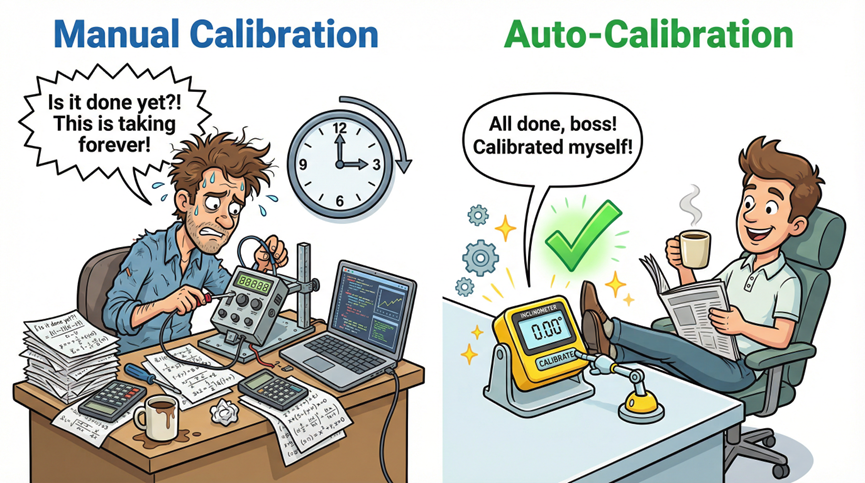
Modern smart inclinometers like the TS-2322-R04 integrate auto-calibration firmware that:
- Continuously monitors internal temperature.
- Applies a pre-characterized polynomial correction (second-order or higher) to null temperature drift.
- Provides a one-touch zeroing routine that subtracts static mounting offsets.
You simply bolt the sensor on, power it up, and walk away. No manual math, no field programming.
Output Flexibility: Analog or Digital – Your Choice
System integrators often juggle legacy PLCs (0–5V or 0–10V analog) alongside modern IoT systems (RS485, CAN bus, Modbus). Stocking separate sensors for each interface is expensive.
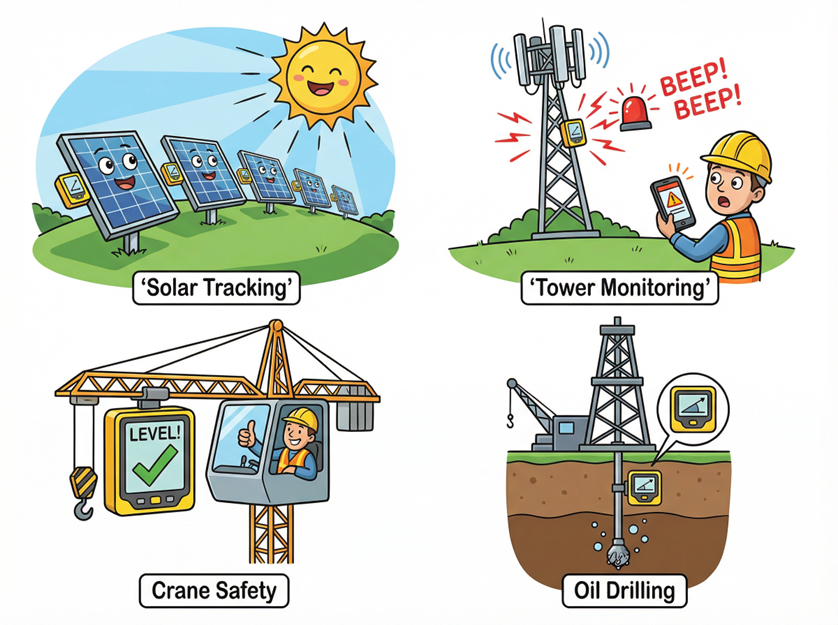
The TS-2322-R04 solves this with optional analog or digital outputs in the same compact, IP67-rated housing. One sensor family covers all projects – from retrofitting a 20-year-old industrial converter to building a brand-new solar tracking array.
Breaking the Cost Myth: $99 vs. $400+
There is a persistent myth that high precision (0.02° resolution), ruggedness (IP67), and advanced filtering require a $300–500 sensor. Legacy brands have happily reinforced this, wrapping basic MEMS chips in unnecessarily heavy enclosures.
But MEMS technology has matured, and firmware is now the differentiator. By embedding Kalman filtering and auto-calibration, AIT Sensing Inc. delivers identical or better performance at $99.

Where to Get It
The TS-2322-R04 is manufactured by AIT Sensing Inc. (AIT). In the United States, it is distributed by Digikey Inc.
For full datasheets, ordering, and technical support:
👉 www.ait-sensor.com/ts-2322-r04
Conclusion
You no longer have to choose between your budget and your data quality. Embedded Kalman filtering and auto-calibration firmware have made 0.02° precision, real-time response, and IP67 ruggedness available at $99. Whether you are monitoring telecommunication towers, leveling medical instruments, or tracking the sun with solar panels, the smartest solution is also the most affordable.
References
[1] AIT Sensing Inc. “Tilt Sensor Product Selection Guide.”
https://www.ait-sensor.com/tilt-sensor-guide
[2] Digikey ”Selecting MEMS Inclinometers for Industrial, Structural,& Robotic Systems”
https://www.digikey.com/en/supplier-centers/analog-technologies
[3] IEEE Xplore. “Noise Processing Method of MEMS Tilt Sensor Using Kalman Filter.”
https://ieeexplore.ieee.org/iel8/6287639/10820123/10933926.pdf
[4] E-Motion Supply. “POSITAL TILTIX CANopen Inclinometer (price reference).”
https://www.e-motionsupply.com/product_p/acs-080-2-ca01-he2-pm.htm
